If you want to import transactions into an expired Quicken Windows file, you can: 1 Create the headers for a downloaded.qif file as listed in a post below (which I would find tedious, even if you cut and paste) and then import that.qif file into Quicken. This works if your bank lets you download a.qif file, which most don't anymore. Quicken 2019 editions are now an annual subscription. Quicken released its latest version, which is available in four subscription levels: Starter, Deluxe, Premier and Home & Business. More importantly, Quicken is now an annual subscription. With the older versions, you had a three-year sunset before you were forced to upgrade.
To import QIF into Quicken (to import a QIF file into Quicken 2005-2014, 2015, 2016, 2017, 2018, 2019, 2020, 2021), you need to create a correct QIF file and follow the instructions below.
QIF and QFX format
Quicken for Windows up to the latest 2020 (and 2019, 2018) version, supports import for QIF and QFX (Web Connect) files. Quicken 2005-2017 imports QIF files. Here are the major differences between QIF and QFX (Web Connect) format when you try to import them under Quicken. Convert QIF to QFX (Web Connect) and import into Quicken 2019, 2018, 2017, 2016 (Win/Mac) This tutorial shows how to convert a QIF file from your bank or credit card statement to QFX (Web Connect) and import into Quicken. We will use QIF2QFX utility. Easily convert from.QIF files to.QFX files with QIF2QFX Convert by MoneyThumb. If you’re wondering how to convert from one Quicken format to another, we have the answer qif2qfx Convert, by MoneyThumb. Quickly and easily convert older or QIF format Quicken files into QFX format files for Quicken import.
Quicken imports QIF and QFX (Web Connect) files with transactions. Once Quicken becomes three years old, it stops import QFX (Web Connect) files. Investing in a converter that creates QIF files from your CSV or OFX or QFX or QBO files is a good idea because you keep using your Quicken version until you see features worthy upgrade to new Quicken version.
QXF format
There is also QXF files that you do not want. Unlike QFX (Web Connect) and QIF files, QXF replace whole data file and can create only from another Quicken that is the same year and the same platform (PC/Mac) as you have. QIF and QFX (web connect) files add transactions to your Quicken file, not replace them.
Yes, Quicken says QIF files are not supported, but yes, QIF files correctly prepared are importable directly into bank or credit account in Quicken. Import QIF into Quicken gives you the ability to supply transactions, as QFX (Web Connect) format does not provide them.
QIF files should be created either by the Transactions app, which converts from more formats and converts to more formats, CSV2QIF - CSV to QIF converter - or Bank2QIF - Bank to QIF Converter - or PDF2QIF - you can use Bank2QIF to ‘fix’ your QIF as well.
Quicken 2005-2017, 2018-2021? You are fine
Quicken 2005, 2006, 2007, 2008, 2009, 2010, 2011, 2012, 2013, 2014, 2017, 2018, 2019, 2020, 2021 imports QIF files fine for all account types. Your QIF file must be correctly created to import directly into an account you need it to import, and CSV2QIF helps you create such QIF files.
When you convert a CSV file to QIF using CSV2QIF, enter the account name exactly as you have in Quicken and select the account type (Bank for checking and savings accounts, CCard for credit card accounts, Invest for investment accounts).
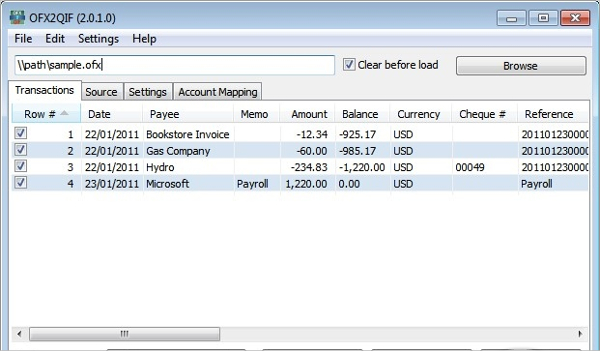
When you convert a bank file (OFX, QFX, QIF, QBO) to QIF using Bank2QIF (Bank to QIF Converter), load the file and click on the Account Mapping tab and enter the account name as you have in Quicken for each listed account.
Once you saved the QIF file, do the following:
Start Quicken and click File, then File Import, then QIF file.
On the import screen, select from the account drop-down list. Ignore the Quicken message about QIF limitations.
Review your imported transactions (Done!).
What about Quicken 2015 and 2016?
Quicken 2015, 2016 have the limitation with QIF import for bank and credit card accounts. You have to use a workaround with a proxy cash account, import transactions there, and then move transactions under a bank or credit account. There a separate tutorial for this conversion and import.
Related articles
|

Q: What is the Quicken interchange format (QIF)?
A: The Quicken interchange format (QIF) is a specially formatted text (ASCII) file that lets you to move Quicken transactions:
- From one Quicken account register into another Quicken account register, or
- To/From another application that supports the QIF format.
Note: For Quicken to translate data from a text file into the Quicken register as transactions, the text file mustbe in the QIF format.
Required File Formatting:
- Each transaction must end with a symbol, indicating the end of entry.
- Each item in the transaction must display on a separate line.
- When Quicken exports an account register or list, it adds a line to the top of the file that identifies the type of account or list. Listed below are the header lines Quicken adds to the exported files:
| Header | Type of data |
| !Type:Bank | Bank account transactions |
| !Type:Cash | Cash account transactions |
| !Type:CCard | Credit card account transactions |
| !Type:Invst | Investment account transactions |
| !Type:Oth A | Asset account transactions |
| !Type:Oth L | Liability account transactions |
| !Account | Account list or which account follows |
| !Type:Cat | Category list |
| !Type:Class | Class list |
| !Type:Memorized | Memorized transaction list |
You can force Quicken to import all transfers, regardless of whether Ignore Transfers is selected when the file is imported. You must add a line to the file being imported into a Quicken account. Use a text editor or word processor to put the following line right after the header line at the top of the file:
!Option:AllXfr
Items for Non-Investment Accounts

Each item in a bank, cash, credit card, other liability, or other asset account must begin with a letter that indicates the field in the Quicken register. The non-split items can be in any sequence:
| Field | IndicatorExplanation |
| D | Date |
| T | Amount |
| C | Cleared status |
| N | Num (check or reference number) |
| P | Payee |
| M | Memo |
| A | Address (up to five lines; the sixth line is an optional message) |
| L | Category (Category/Subcategory/Transfer/Class) |
| S | Category in split (Category/Transfer/Class) |
| E | Memo in split |
| $ | Dollar amount of split |
| ^ | End of the entry |
Note: Repeat the S, E, and $ lines as many times as needed for additional items in a split. If an item is omitted from the transaction in the QIF file, Quicken treats it as a blank item.
Items for Investment Accounts
| Field | IndicatorExplanation |
| D | Date |
| N | Action |
| Y | Security |
| I | Price |
| Q | Quantity (number of shares or split ratio) |
| T | Transaction amount |
| C | Cleared status |
| P | Text in the first line for transfers and reminders |
| M | Memo |
| O | Commission |
| L | Account for the transfer |
| $ | Amount transferred |
| ^ | End of the entry |
Items for Account Information

The account header !Account is used in two places-at the start of an account list and the start of a list of transactions to specify to which account they belong.
| Field | IndicatorExplanation |
| N | Name |
| T | Type of account |
| D | Description |
| L | Credit limit (only for credit card accounts) |
| / | Statement balance date |
| $ | Statement balance amount |
| ^ | End of entry |
Items for a Category List
| Field | IndicatorExplanation |
| N | Category name:subcategory name |
| D | Description |
| T | Tax related if included, not tax related if omitted |
| I | Income category |
| E | Expense category (if category type is unspecified, quicken assumes expense type) |
| B | Budget amount (only in a Budget Amounts QIF file) |
| R | Tax schedule information |
| ^ | End of entry |
Items for a Class List
| Field | IndicatorExplanation |
| N | Class name |
| D | Description |
| ^ | End of entry |
Items for a Memorized Transaction List
Immediately preceding the ^ character, each entry must end with one of the following file indicators to specify the transaction type.
- KC
- KD
- KP
- KI
- KE
With that exception, memorized transaction entries have the same format as regular transaction entries (non-investment accounts). However, the Date or Num field is included. All items are optional, but if an amortization record is included, all seven amortization lines must also be included.
| Field | IndicatorExplanation |
| KC | Check transaction |
| KD | Deposit transaction |
| KP | Payment transaction |
| KI | Investment transaction |
| KE | Electronic payee transaction |
| T | Amount |
| C | Cleared status |
| P | Payee |
| M | Memo |
| A | Address |
| L | Category or Transfer/Class |
| S | Category/class in split |
| E | Memo in split |
| $ | Dollar amount of split |
| 1 | Amortization: First payment date |
| 2 | Amortization: Total years for loan |
| 3 | Amortization: Number of payments already made |
| 4 | Amortization: Number of periods per year |
| 5 | Amortization: Interest rate |
| 6 | Amortization: Current loan balance |
| 7 | Amortization: Original loan amount |
| ^ | End of entry |
Examples of QIF files
Normal Transactions Example
| Transaction Item | Comment (not in file) |
| !Type:Bank | Header |
| D6/ 1/94 | Date |
| T-1,000.00 | Amount |
| N1005 | Check number |
| PBank Of Mortgage | Payee |
| L[linda] | Category |
| S[linda] | First category in split |
| $-253.64 | First amount in split |
| SMort Int | Second category in split |
| $-746.36 | Second amount in split |
| ^ | End of the transaction |
| D6/ 2/94 | Date |
| T75.00 | Amount |
| PDeposit | Payee |
| ^ | End of the transaction |
| D6/ 3/94 | Date |
| T-10.00 | Amount |
| PJoBob Biggs | Payee |
| MJ.B. gets bucks | Memo |
| LEntertain | Category |
| A1010 Rodeo Dr. | Address (line 1) |
| AWaco, Tx | Address (line 2) |
| A80505 | Address (line 3) |
| A | Address (line 4) |
| A | Address (line 5) |
| A | Address (line 6) |
| ^ | End of the transaction |
Investment Example
| Transaction Item | Comment (not in file) |
| !Type:Invst | Header line |
| D8/25/93 | Date |
| NShrsIn | Action (optional) |
| Yibm4 | Security |
| I11.260 | Price |
| Q88.81 | Quantity |
| CX | Cleared Status |
| T1,000.00 | Amount |
| MOpening | Balance Memo |
| ^ | End of the transaction |
| D8/25/93 | Date |
| NBuyX | Action |
| Yibm4 | Security |
| I11.030 | Price |
| Q9.066 | Quantity |
| T100.00 | Amount |
| MEst. price as of 8/25/93 | Memo |
| L[CHECKING] | Account for transfer |
| $100.00 | Amount transferred |
| ^ | End of the transaction |
Memorized List Example
| Transaction Item | Comment (not in file) |
| !Type:Memorized | Header line |
| T-50.00 | Amount |
| PJoe Hayes | Payee |
| MRent | Memo |
| KC | Check transaction |
| ^ | End of the transaction |
| T-25.00 | Amount |
| T-25.00 | Company Payee |
| LTelephone | Category |
| KP | Payment transaction |
| ^ | End of the transaction |
©Intuit Inc. 1997

Importing .qif File Into Quicken Deluxe 2018
QNFAQ QNDOS QNOTHER